


Lost in limbo: the long and frustrating road to an MND diagnosis
Advocacy, Awareness, Community, Education
18 May 2026
For many people, motor neurone disease (MND) begins in confusion. Early symptoms are often missed or misunderstood, sending people on a frustrating circuit of appointments, tests and misdiagnoses. For Judith Jones (81), it was eight years from her first symptoms to her recent diagnosis, and she is shocked by the lack of awareness of the disease. During those eight years she was told by two medical specialists her inability to walk properly was ‘just ageing’.
Eight years’ ago, Judith started to notice her legs were very tired and numb. She put it down to the hard, ceramic tiles on the floor of her and her husband Allen’s Kerikeri home.
“It wasn’t too bad, but every now and then I’d sink to the ground as my legs went numb,” she recalls.
A year later, the couple moved to Cambridge. Judith’s new GP saw her walking into the room clutching bannisters and railings and sent her to an orthopaedic surgeon. “He looked at my x-ray and MRI and said, ‘Oh, this is just an ageing spine’ and lost interest. Then he referred me to a geriatrician,” explains Judith.
Judith had two or three appointments with the geriatrician who finally told her she just had ageing legs. However, she knew there was something more to it than that. She pointed out that there were 150 other people in her retirement village in Cambridge in their 70s, 80s and 90s, and none of them struggled to walk in the same way she did.
“I asked the geriatrician if I should see a neurologist and he said, ‘Well if you want to waste time and money you can’, so that was that. I just went home and accepted there was nothing much I could do.”
An osteopath visit was a last-ditch attempt to find answers. He thought there was something more to Judith’s symptoms and suggested she ask her GP for blood tests. While her GP ‘hit the roof’ that someone other than a doctor was suggesting what he should do, he immediately put her on an urgent list to see a neurologist.
The long-overdue neurology referral saw her spend a week in hospital having a range of tests. She was finally diagnosed with the rare, slower-progressing form of motor neurone disease known as primary lateral sclerosis (PLS). It has a longer life expectancy than the more common ALS variant, of more than 10 years from onset of symptoms.

Judith and Allen met in 1967 at the Wellington Underwater Club. Judith was learning to dive with her cousins, and Allen was her diving instructor. They have enjoyed an active 57-years of married life together – tramping, cycling, gardening, embarking on off-road driving adventures, and sailing around the Pacific in their self-built steel yacht.
Difficulties with walking have now forced Judith to use a wheelchair or power chair outside of the house and a walker inside. Allen has taken over the shopping and the cooking. “I can open tins quite well now,” jokes Allen, while Judith laughs at how much he loves going shopping.
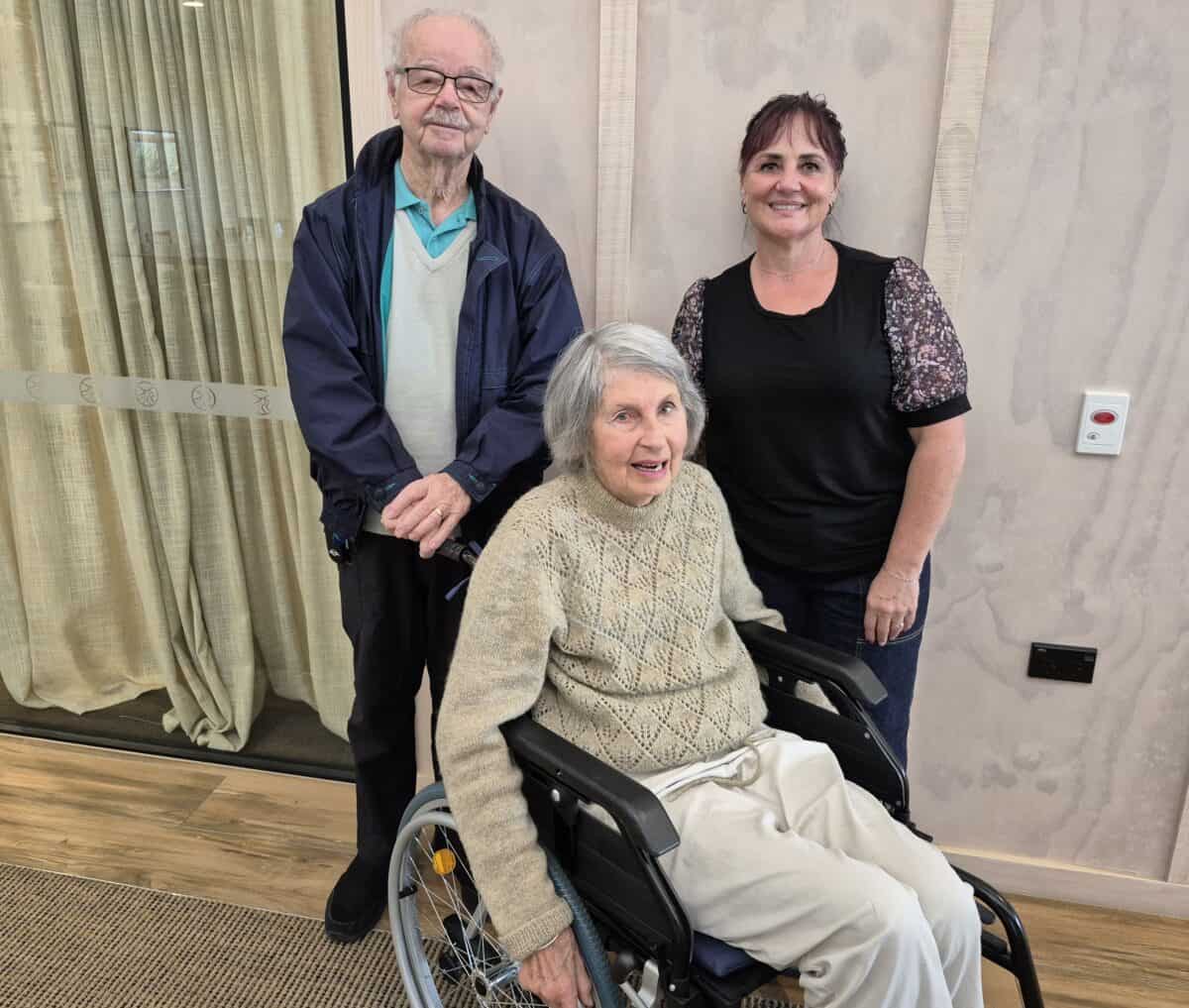
They attend the Motor Neurone Disease NZ Connect Group in Cambridge run by MND NZ Regional Support Advisor Cat Taylor (pictured above with Judith and Allen). In that group they have connected with another person diagnosed with the PLS variant of MND which has been helpful.
While she has managed to continue with her daily 20-minute indoor bike sessions, lately Judith has noticed she involuntarily slurs her words a little after the exertion.
The couple have a positive outlook and are pragmatic about their own challenges. Their concern is how many people, including medical specialists, have never heard of MND. And they hope that by sharing their story, it will help pave the way to a faster diagnosis to help make time count for others. “If I hadn’t by chance gone to an osteopath, who doesn’t have a medical degree, I would still be undiagnosed,” concludes Judith.
The MND NZ Red Flags for MND health professionals’ resource is an easy-to-use, two-page guide to support decisions on whether patient symptoms could be MND and require referral.