



MND Insight Research findings send a strong message for better funded care
Advocacy, Community, Research, Support
29 October 2026
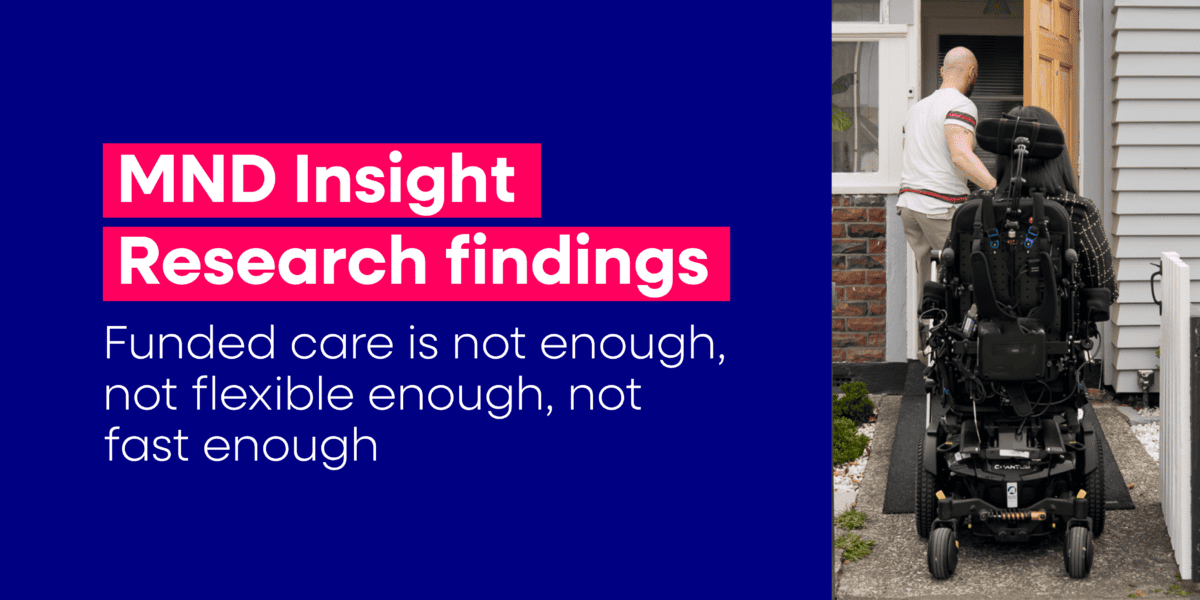
Around half of survey respondents with motor neurone disease (MND) who receive funded care say it isn’t enough, reports recently published MND Insight Research.
The research provides strong evidence of what Motor Neurone Disease NZ (MND NZ) Support Advisors see every day: that better access to more adequate funded care would ease the burden on people with MND and their families, and help family carers remain in paid work for longer.
Key research findings
The research found that most people with MND (77%) rely on their family for substantial unpaid care because of inadequate funded care and residential respite provision in New Zealand. The research also found that 44% of those needing funded care reported difficulty accessing it, and of those who received funded care 51% reported that funded hours were insufficient.
These findings were enabled by the generous responses of people with MND and their family members who participated in 2025 MND Insight Research in New Zealand distributed through MND NZ networks.
Dr Natalie Gauld, who led the research, notes: “Funded care needs to be more responsive to the needs of people with MND and their caregivers. When a person has MND, it needs to be easy to get funded care hours and to get them increased quickly to respond to changing needs.
MND NZ advocacy
Funded and supported by Motor Neurone Disease NZ, Health Research Council and Natalie Gauld, the research provides important information that is helping MND NZ continue to advocate for improvements and equity in funding.
Mark Leggett, MND NZ’s Chief Executive, says: “This research gives us the robust evidence to back up the advocacy we already do – helping us to effectively push for change. It directly informed our submission on the Disability Support Services Bill, prior to publication earlier this year, and we’ll keep using findings like these to continue to advocate for funded care that responds to what people with MND and their families need.”
What can you do if you or your loved one have MND?
MND NZ Support Services Manager Toni Foster says she is grateful for the research findings that back up the advice and support that the organisations’ ten regional support advisors provide every day:
- Make sure you start the care hours referral process as early as possible – your MND NZ support advisor can help you with this.
- Discuss with your MND NZ support advisor and NASC needs assessor how to prepare for rapidly changing needs.
- Contact your needs assessor as your needs change.
- If you don’t have enough care hours, tell your needs assessor immediately.
MND Insight Research suggests change is needed
The evidence suggests the following changes are needed to the government funding model:
- Clear, accessible information about what funded care people are entitled to and how to get it. Families report difficulty navigating the system, and a lack of clear information about what they qualify for.
- Adequate funded care hours to help more family members remain in paid work where they wish to, reducing financial strain and the difficulty of returning to work.
- Funded care that responds rapidly to the fast-changing nature of MND. The flexibility to increase hours as needs change is paramount. Faster needs assessments and faster set-up of care are required.
- Funding that covers the full range of tasks families affected by MND need help with. Assessments should recognise needs that are additional to caring for the person with MND: household chores, gardening, meals, coordinating care, and support at appointments.
- More flexible respite and support models. Respite gives carers time to rest and recover and enables people with MND and their families to spend quality non-caring time together. Flexible respite and support should respond to the family’s needs, and should include in-home support for people with MND who prefer to stay at home.
- Workforce needs in disability and home support services must also be considered, so that staff are trained to flexibly respond to complex and rapidly changing needs.
To read the full paper go to: https://onlinelibrary.wiley.com/doi/10.1111/jocn.70548